
Sometimes the hardest part of growth isn’t learning what to do. It’s doing it.
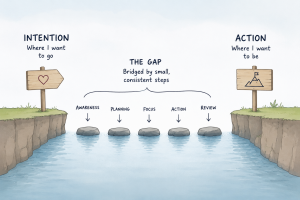
That idea sat with me after my conversation with Dr. Radhika Achari. We talked about growth mindset, behavior, confidence, leadership, parenting, and the stories we tell ourselves when life feels stuck. What stood out most was this: knowing is not the same as doing. There’s a whole chain of steps in between.
If you’ve ever thought, “I know what I should do, so why can’t I just do it?” you’re not broken. You’re probably dealing with a mix of environment, habits, energy, stress, and self-belief. That’s a lot to carry. The good news is that progress doesn’t have to start with a huge leap. Often, it starts with one small shift that actually fits real life.
In this post, I’m breaking down the biggest ideas from that conversation: why some things come easily to some people and not others, why advice can feel simple but still be hard to follow, how systems reduce stress, and how small wins can change how we see ourselves.
Why growth feels easier for some people than others
In short: Some skills feel natural, while others take more effort, and that difference does not define our worth.
One of my favorite parts of the conversation was when Dr. Achari talked about growing up in a large family and noticing how some things came naturally to certain siblings or cousins, while other things took more work. That felt very real to me.
We’ve all had that moment. Someone next to us seems to “get it” right away, while we’re still trying to make sense of it. That can stir up shame fast. Yet Dr. Yatari offered a healthier way to see it: different strengths are not a flaw in the system. They are the system.
She used the image of an escape room. If everyone had the same skill set, no one would solve much. We need different ways of thinking. We need the person who sees patterns, the one who stays calm, the one who asks better questions, and the one who notices what everyone else missed.
That matters even more in neurodivergent spaces. Comparing yourself to someone else’s timeline, job, family life, or social ease is a fast way to feel defeated. Reflection works better than comparison. I keep coming back to this question: What comes naturally to me, and what support do I need for the rest?
Why knowing what to do still doesn’t lead to action
In short: The gap between intention and action is shaped by energy, stress, environment, and how easy a behavior is to start.
Dr. Acharii put it plainly: everyone knows what healthy food is, but not everyone eats healthy all the time. That’s because behavior doesn’t live in a vacuum. It lives in real life.
Knowing something is useful. But action also depends on:
- Your energy level
- Your schedule
- Your stress load
- Your physical space
- Your habits
- Your support system
That’s why simple advice can still feel impossible. Advice often skips the middle. It tells us what to do, but not how to make it fit our life.
One example from the conversation was the classic advice, “Don’t go to bed angry.” Sounds simple. But what if late-night talks make things worse? What if one person needs sleep before they can think clearly? The real answer wasn’t to force that advice. It was to build a better system: make space at a better time for hard conversations.
That’s the pattern I keep seeing. Advice works better when I treat it as a reflection prompt, not a rule.
How systems reduce stress and support executive functioning
In short: Systems lower mental load by giving important tasks and objects a clear place and routine.
This part of the conversation was especially practical. Dr. Yatari talked about people who keep losing keys, phones, sunglasses, or school items. The issue often isn’t carelessness. It’s that the item has no home.
That’s where systems help.
If there’s always a pile by the door, don’t just move the pile. Build a drop zone. Add a hook, tray, basket, or small box. Give each object a place. Then the brain doesn’t have to keep solving the same problem every day.
That matters for executive functioning. When I reduce the number of choices and reminders I need to hold in my head, I free up energy for everything else.
Examples of simple systems that actually help
In short: The best systems are visible, repeatable, and easy to use on hard days.
- Put keys, phone, and wallet in the same place every time
- Add Zoom links or appointments directly into a digital calendar
- Set out clothes or supplies the night before
- Create a recap habit after classes, meetings, or calls
- Break chores into zones instead of one giant “clean everything” task
There’s a quiet relief that comes from predictability. It reduces anxiety, builds confidence, and helps us stay present instead of scrambling.
If a task keeps going wrong, I try to stop blaming myself and start asking what system is missing.
[IMAGE SUGGESTION: A neat entryway with labeled hooks, basket, shoes, and keys in one place]
How small wins build confidence
In short: Small successes create momentum, and momentum helps us believe progress is possible.
One of the most useful ideas from the conversation was this: start with something small enough that you can finish it. That early success matters.
Dr. Achari talked about using easy tasks to build momentum, much like answering the easier test questions before tackling the hardest one. That doesn’t mean avoiding challenge. It means building enough traction to face it.
She also shared a behavior science idea called permanent product. That means doing something where the result is visible. Make the bed. Clear the desk. Sort one shelf. When I can see the progress, it helps the progress feel real.
I also liked her reframing of self-doubt: not as a verdict, but as data.
Instead of saying, “I’m just not good at this,” try:
- “I haven’t learned this yet.”
- “What support do I need?”
- “What would make this easier to start?”
- “What if I gave this 10 minutes?”
That tiny word yet does a lot of heavy lifting. It turns a dead end into a path.
What really keeps us stuck: the stories we repeat
In short: Fixed self-stories can trap us, especially when they grow from shame, comparison, or pressure to fit in.
Dr. Achari said something that stayed with me: a huge part of being stuck comes from the stories we tell ourselves about what we can’t do. Sometimes those stories feel like facts because we’ve repeated them for years.
Maybe the story is:
- “I don’t have time.”
- “People don’t want to hear from me.”
- “I’m bad at this.”
- “I should be further along by now.”
- “If I can’t do it perfectly, there’s no point.”
Those beliefs don’t always come out of nowhere. They can come from old comparisons, family roles, school experiences, workplace pressure, or years of masking. They can also grow in environments that reward burnout, overwork, or fitting in at the cost of being real.
So how do I question a story that feels true?
Use the “What if” question
In short: “What if” creates enough space to imagine a different next step.
Dr. Yatari uses a simple model: What if?
What if I could make 10 minutes for this?
What if this goal is too big right now, and I need a smaller version?
What if I need a backup plan instead of more pressure?
What if the problem isn’t laziness, but overload?
That question doesn’t demand a perfect answer. It just opens the window a little.
Why environment matters at home, at school, and at work
In short: People do better when the environment supports their needs, values, and sense of safety.
We also talked about leadership and culture, and the lesson carries across every setting. A person’s behavior is shaped by the space around them.
A workplace that rewards high performers with more work and less time shouldn’t be shocked when burnout follows. A classroom that values speed over understanding will miss a lot of real learning. A home that expects every child to respond the same way is going to run into trouble, because children are not copy-and-paste humans.
Growth needs psychological safety. That can mean one-on-one feedback instead of public correction. It can mean shared activities instead of face-to-face pressure. It can mean fewer abstract directions and more clear practice. It can also mean building community where people don’t have to hide who they are to belong.
That’s not softness. That’s good support.
Key takeaways
- Knowing what to do is only one part of change.
- Action gets easier when the environment supports it.
- Systems reduce cognitive load and make routines easier to keep.
- Small wins build momentum and confidence.
- “I’m not good at this” works better as “I haven’t learned this yet.”
- Advice needs to fit real life, not just sound simple.
- Different strengths are not a weakness; they’re part of how people learn and contribute.
- Growth should support your life, not turn it into one endless self-fix project.
FAQ
What is the difference between knowing and doing?
In short: Knowing is mental understanding; doing requires support, energy, and action steps.
You can understand a goal and still struggle to act on it. The missing link is often environment, routine, stress, or lack of a clear starting point.
How do I build a growth mindset in real life?
In short: Start by treating mistakes as data and progress as practice.
Use phrases like “not yet,” focus on one small next step, and reflect on what support would help rather than using failure as proof that you can’t improve.
Why do small wins matter so much?
In short: Small wins create momentum and help the brain notice success.
When I finish a task I can see or cross off, it gives me proof that progress is happening. That makes the next task feel more possible.
How can I stop feeling stuck?
In short: Make the goal smaller, question the story, and build a system around the task.
Ask what is really getting in the way. Then create a version of the task that fits your current energy, time, and environment.
Conclusion
If I had to sum up the conversation in one sentence, it would be this: progress works better than pressure.
We do not need to become entirely different people. We need better support, better reflection, and better systems that fit who we are right now. That’s true in parenting, learning, work, relationships, and self-understanding.
So if you’ve been feeling behind, stuck, or frustrated with yourself, I hope this helps you pause and ask a kinder question. Not “Why can’t I do this already?” but “What would help me take one real step?”
If this spoke to you, I’d invite you to keep the conversation going. Share this with someone who needs the reminder, and take five or ten minutes today to name one small change that would make life feel a little easier.


No Comments