
Most of us look at the ocean and see the surface. We see waves, a shoreline, maybe a storm rolling in. But after my conversation with Helen Czerski, I’ve been thinking about the ocean in a very different way. I’m not just seeing water anymore. I’m seeing a living physical system that shapes weather, climate, movement, and life across the planet.
In short: the ocean is not some far-off backdrop. It is an active part of our world, and the more I understand it, the more connected everything feels.
That was one of the biggest ideas I took from this conversation. Helen didn’t talk about the ocean as a mystery box full of strange things. She talked about it as something real, knowable, and already deeply tied to our lives. At the same time, she made room for wonder, beauty, and curiosity. That balance stuck with me
What Is Happening Beneath a Wave?
In short: a breaking wave is not just surface drama. It is full of motion, air, bubbles, and physics happening just below what we can see.
One of my favorite parts of the conversation was hearing Helen describe what she sees when she looks at a wave. Most of us notice the crash. She notices the hidden activity just under the surface.
She explained that many of the breaking waves on Earth are not the ones we see at the beach. Most are far out in the open ocean, where strong winds create them in real time. That alone changed how I picture the sea. The beach is only one tiny part of the story.
Then there are the bubbles. When a wave breaks, it traps air and creates a plume of bubbles beneath the surface. Those bubbles change, move, rise, and sometimes dissolve completely. It all happens fast, and much of it happens in the top half meter of water.
That level of detail could sound technical, but Helen made it feel vivid. She described bubbles as rounded, wobbling, light-catching shapes. Small ones stay nearly spherical. Bigger ones flatten out. Some can even look like little umbrellas. So yes, there is physics there. But there is also beauty.
Knowing the science doesn’t take beauty away. It adds more to see.
That idea matters to me because a lot of people were taught to think of science as cold or distant. This conversation reminded me that science can make the world feel richer, not smaller.
Why the Ocean Is Often Misunderstood
In short: we underestimate the ocean because we mostly judge the world by what we can easily see, and the ocean hides a lot from view.
Helen made a point that stayed with me: humans are often superficial in the literal sense. We look at surfaces and assume we understand the whole thing. The ocean makes that habit fail.
We can’t move through it easily. We can’t breathe in it without special equipment. We also can’t see very far into it, even though many of us think water is clear. In reality, light does not travel far underwater, and most of the ocean is dark.
So even when we are looking right at the sea, we may still miss the ocean itself.
We notice boats, birds, foam, and the horizon. But we do not naturally see the ocean as one connected physical system that affects rainfall, temperature, weather patterns, and life on land. That gap in understanding has consequences. If we treat the ocean as “other,” it becomes easier to ignore how much it matters.
Helen pushed back on calling the ocean mysterious, and I understood why. Calling something a mystery can sound poetic, but it can also become a way to close the door on it. If something feels distant or unknowable, it is easy to stop thinking about it.
Her point was simple and strong: the ocean is not separate from our world. It is part of the engine of Earth.
- It affects where the planet is hot and cold.
- It influences weather and climate.
- It helps drive water cycles and rainfall.
- It connects regions people often think of as separate.
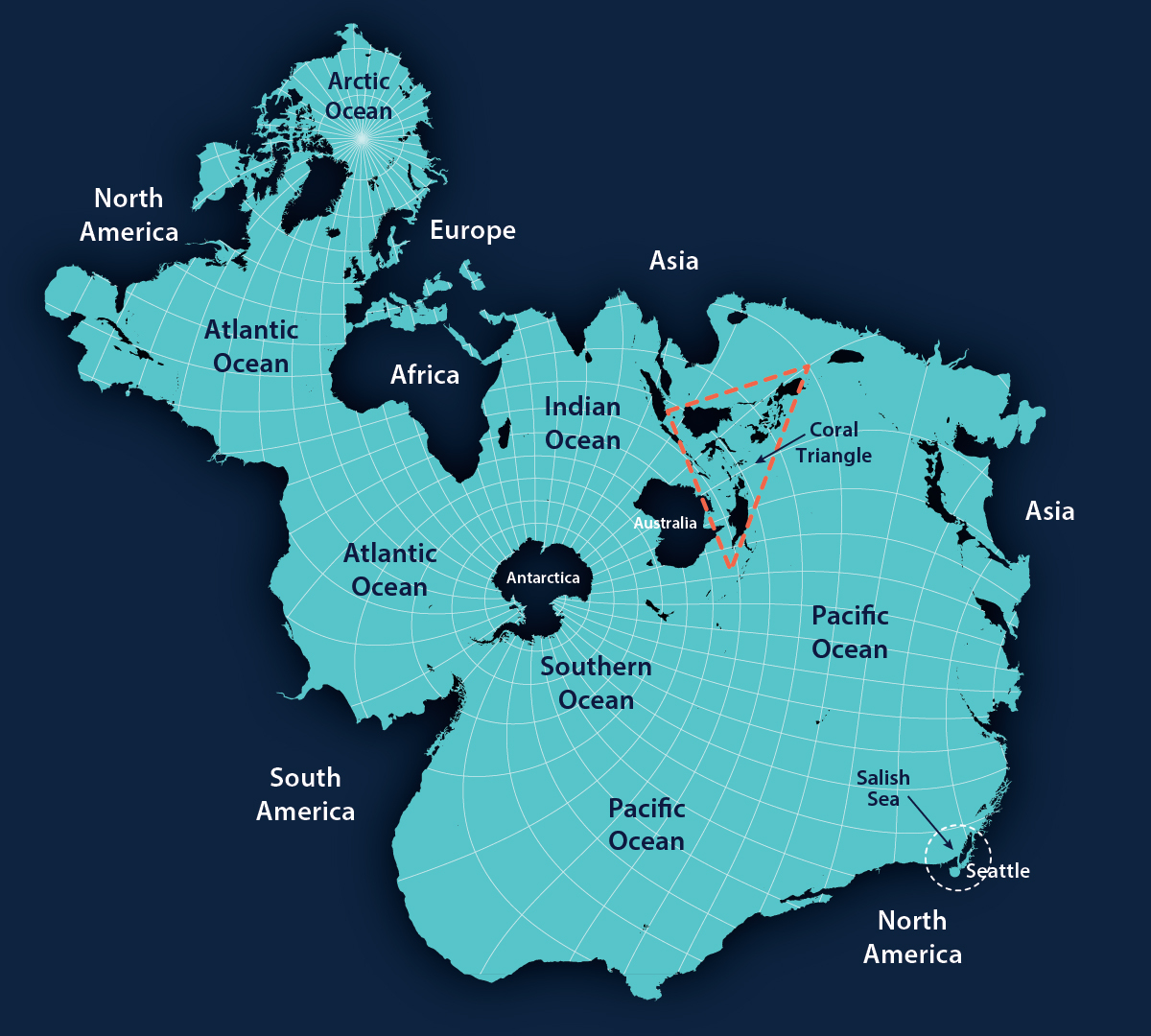
That last point came through clearly when she talked about the ocean as one connected body of water, not a set of isolated oceans. She mentioned the Spilhaus projection, a way of mapping the planet that cuts the land rather than the ocean, so the connected global ocean becomes obvious. I love that image because it shifts the frame without changing the facts.
How Curiosity Actually Works
In short: curiosity does not have to be dramatic or intense. It can be steady, ordinary, and built through simple questions.
I appreciated how honest Helen was about her own path. She didn’t tell some big origin story where one magical moment changed everything. She said she was simply interested in how the world works, and the people around her responded with, “Let’s find out.”
There is something comforting in that.
Not every curious mind starts with obsession. Sometimes curiosity looks like holding many interests at once. Sometimes it looks like asking questions, reading, testing ideas, and paying attention. That felt especially important because so many people assume science belongs only to specialists.
Helen argued the opposite. In her view, we can all think scientifically. If I test a recipe, make notes, change one variable, and try again, I’m using the same basic pattern. If I compare how seeds grow under different conditions, same thing. If I spin a boiled egg and a raw egg to see what happens, that’s physics in action at a kitchen table.
That is a helpful reminder: science is not just a place with lab coats and equipment. It is a way of noticing, testing, and learning.
What helps when science feels intimidating?
In short: keep the question, ask it anyway, and do not assume you are too late to learn.
One part of the conversation I really wanted to hold onto was this: if I have a question, it is worth asking. Adults often talk themselves out of curiosity. We tell ourselves we should already know, or we’re too busy, or the question is too small. But small questions are often where understanding begins.
Helen’s advice was to hold on to the question and go looking. Not every answer will be easy to find. Not every source online will be reliable. Still, the act of asking matters.
That message fits something I care about deeply: making learning feel accessible, not guarded.
Why Storytelling Matters in Science
In short: people do not connect with information by data alone. We connect through narrative that gives meaning and context.
This part of the conversation hit home for me as a host. Helen said humans make sense of the world through narrative. I agree. If I want someone to care about an idea, I can’t just hand over facts and hope they stick. I have to show why it matters and how the pieces connect.
She shared a memory from a science communication event where a judge told her, “What you did is brilliant, but you didn’t make me care.” That line is sharp, and it’s true far beyond science.
People need context before they can hold onto information.
At the same time, Helen warned against making attention the only goal. We live in a world that often rewards the quick grab and forgets substance. A short burst of interest is not the same as understanding. A real narrative gives someone a framework. It gives them something they can carry forward.
That is exactly why conversations like this matter to me. They create space for ideas to settle. They help us connect facts to meaning.
If I want someone to care, I need to offer more than a hook. I need to offer a way of seeing.
What the Ocean Teaches Me About Being Human
In short: the ocean teaches humility, respect, and our place inside something much larger than ourselves.
Helen spoke about awe in a way I found really powerful. Awe is the feeling of being small in the presence of something bigger. And rather than making us feel worse, that feeling can actually help. It can make us kinder, calmer, and more grounded.
I think that lands because so much of modern life pushes the opposite message. It tells us to center ourselves constantly. Yet many of us feel better when we remember we are part of something larger.
The ocean makes that easy to feel.
But it also demands respect. Helen shared the kind of wisdom people near the ocean learn quickly: never turn your back on it. The ocean is not there for us to control. We can work with it, learn from it, and move with care. But if we treat it casually, it will remind us who is stronger.
That is not fear talking. It is humility. And honestly, humility is not a bad lesson to keep close.
[IMAGE SUGGESTION: a person standing safely at a shoreline looking out at a large sea, emphasizing scale and perspective]
Key Takeaways
- The ocean is not separate from daily life. It helps shape climate, weather, and the physical systems of Earth.
- Breaking waves contain a lot of hidden activity, especially bubbles and motion just below the surface.
- Knowing science can make nature feel more beautiful, not less.
- Calling the ocean a mystery can create distance. It is better to see it as a connected, knowable part of our world.
- Curiosity does not need to be dramatic. Simple questions and everyday experiments count.
- Good science communication makes people care by giving facts meaning through narrative.
- The ocean teaches humility, respect, and our place within something bigger.
FAQ
Why does the ocean matter even if I do not live near it?
The ocean affects weather, rainfall, temperature, and the wider climate system. Even far from the coast, life is shaped by what the ocean is doing.
Does learning the science of nature make it feel less beautiful?
No. In this conversation, the opposite was true. Understanding how something works can add more layers of beauty because I can imagine what is happening beyond what I first see.
Is the ocean really one connected system?
Yes. Different regions have different features, but the global ocean is connected. That is one reason ocean-centered maps like the Spilhaus projection are so useful.
What if science feels intimidating?
I’d start small. Keep the question. Ask it. Try simple observations or experiments in daily life. Science is not only for specialists. It is a way of exploring the world.
Why is storytelling important in science communication?
Because people remember meaning better than isolated facts. A strong narrative helps ideas make sense and gives them context.
Conclusion
If there’s one thing I’m taking from this conversation, it’s this: the ocean is not a faraway subject for specialists. It is part of the world I already live in. And the same is true of curiosity. I do not need to be in a lab or hold a title to ask better questions, notice patterns, and care more deeply about how things work.
That’s what I loved about talking with Helen. She brought together physics, beauty, humility, and story without making any of it feel out of reach.
If this gave you a new way to think about the ocean, I’d encourage you to keep going. Ask the next question. Look a little longer at the ordinary things around you. There’s often more going on than we first notice, and sometimes that’s where the best conversations begin.

No Comments